

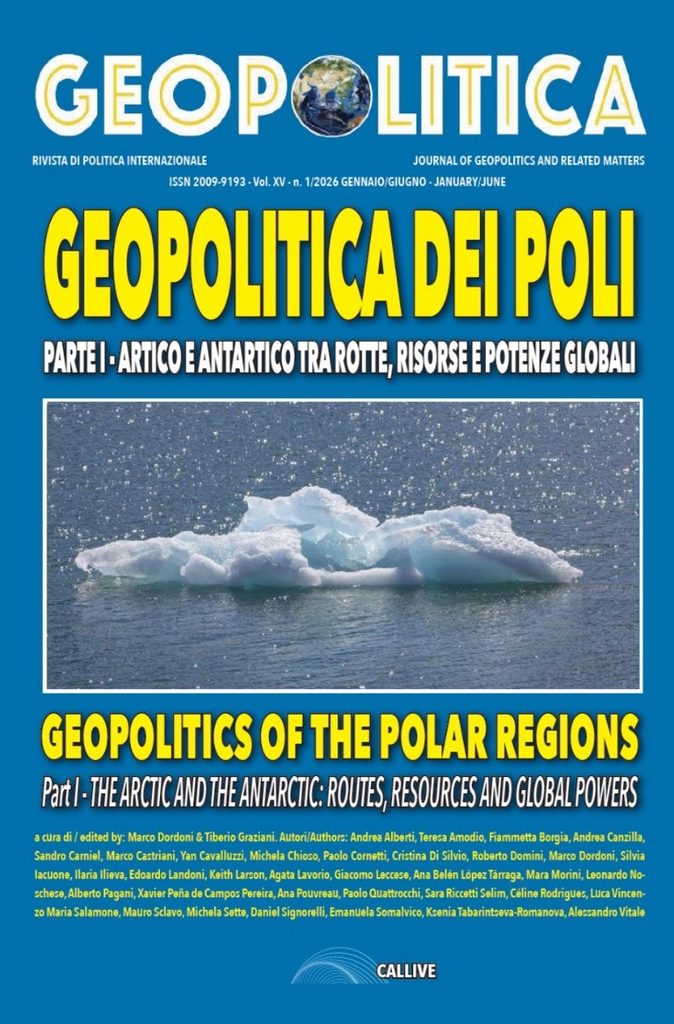
GEOPOLITICA DEI POLI
PARTE I – ARTICO E ANTARTICO TRA ROTTE, RISORSE E POTENZE GLOBALI
GEOPOLITICS OF THE POLAR REGIONS
PART I – THE ARCTIC AND THE ANTARTICT: ROUTES, RESOURCES AND GLOBAL POWERS
a cura di/edited by: Marco Dordoni & Tiberio Graziani
Autori/Authors: Andrea Alberti, Teresa Amodio, Fiammetta Borgia, Andrea Canzilla, Sandro Carniel, Marco Castriani, Yan Cavalluzzi, Michela Chioso, Paolo Cornetti, Cristina Di Silvio, Roberto Domini, Marco Dordoni, Silvia Iacuone, Ilaria Ilieva, Edoardo Landoni, Keith Larson, Agata Lavorio, Giacomo Leccese, Ana Belén López Tárraga, Mara Morini, Leonardo Noschese, Alberto Pagani, Xavier Peña de Campos Pereira, Ana Pouvreau, Paolo Quattrocchi, Sara Riccetti Selim, Céline Rodrigues, Luca Vincenzo Maria Salamone, Mauro Sclavo, Michela Sette, Daniel Signorelli, Emanuela Somalvico, Ksenia Tabarintseva-Romanova, Alessandro Vitale.
-
Dal margine al centro: la Russia, i BRICS e la trasformazione geopolitica dell’Artico / From the Margins to the Center: Russia, the BRICS, and the Geopolitical Transformation of the Arctic
Andrea Alberti (Bank Austria)
ABSTRACTThis article examines the Arctic as a strategic region where the transformation of the contemporary international order becomes particularly visible. The study aims to explain how shifting power balances, the erosion of traditional governance frameworks, and the rise of emerging actors are reshaping regional dynamics and contributing to an increasingly multipolar system. The research adopts a qualitative geopolitical and geoeconomic approach, combining analysis of official policy documents, energy and infrastructure developments, and open-source intelligence with the examination of primary sources and strategic narratives related to Arctic governance and connectivity projects. Attention is devoted to Russia’s Arctic strategy, including the development of the Northern Sea Route and major energy initiatives, interpreted as tools to enhance strategic autonomy, economic diversification, and international positioning. The analysis also assesses the growing involvement of non-Western actors, especially China and India, together with the expanding institutional role of the BRICS framework in promoting financial, technological, and scientific cooperation. The findings indicate that the Arctic is emerging as a pivot area of systemic competition, where alternative economic, logistical, and energy networks increasingly challenge Euro-Atlantic structures. The study concludes that Arctic dynamics reflect broader processes of global rebalancing and highlights the need to integrate the region more systematically into analyses of multipolar governance, strategic interdependence, and global economic connectivity.
KEYWORDS: Multipolarity; BRICS; Rising powers. -
Porti e infrastrutture retroportuali a supporto del traffico artico: una prospettiva geografica / Ports and Hinterland Infrastructure Supporting Arctic Traffic: A Geographical Perspective
Teresa Amodio (Professore Ordinario di Geografia economico politica, Responsabile scientifico Laboratorio Sistemi Informativi Geografici per l’Organizzazione del Territorio, Università degli Studi di Salerno), Daniel Signorelli (Personale Tecnico, Laboratorio Sistemi Informativi Geografici per l’Organizzazione del Territorio, Esperto GIS e immagini satellitari, Università degli Studi di Salerno)
ABSTRACTStarting from a geomapping representation of glacier melt, this research aims to analyze the port and hinterland landscape in support of the new Arctic shipping routes. The possibility of utilizing alternative shipping routes—and particularly the Northern Sea Route—requires the existence of territorial conditions linked to the geopolitics of ports and land-based infrastructure that support these new maritime transport opportunities. Methodologically, an initial representation of the new navigable areas resulting from glacial melting is created through the acquisition and analysis of satellite data processed in a GIS environment. In this regard, remote sensing images from different years will be compared to illustrate the changes that have occurred and the creation of new navigable spaces and routes. Concurrently, a mapping of the network of Arctic ports will be carried out, including their national affiliation, size, and facilities, based on which the trend in transit capacity and the resulting role in global transshipment will be reconstructed. A detailed analysis will focus on the land-based infrastructure developed by coastal states with a view to enhancing the opportunities offered by Arctic routes compared to traditional and established maritime transport routes. The summary cartographic overview aims to illustrate the existing territorial infrastructure in the area. The purpose of the study is to provide a geographical framework to support more strictly political and geopolitical analyses.
KEYWORDS: Glacier melt; Ports and inland ports; Cartography. -
Extracting in a Warming Arctic: Deep-Sea Mining, Sovereign Rights, and Environmental Vulnerability under UNCLOS
Fiammetta Borgia (Full Professor of International Law, Department of Law, University of Rome Tor Vergata), Luca Vincenzo Maria Salamone (General Director, Italian Space Agency)
ABSTRACTThe emerging prospect of deep-sea mining in the Arctic raises a broader question about the law of the sea’s capacity to accommodate intensifying geopolitical and environmental pressures in a warming region. As declining sea ice expands access to seabed minerals critical for energy transition and technological development, Arctic coastal States increasingly articulate strategic interests within the jurisdictional framework of the United Nations Convention on the Law of the Sea (UNCLOS). This article argues that UNCLOS has provided a stable legal structure through which Arctic competition is channeled, legitimized, and contained. By allocating sovereign rights over maritime zones and embedding procedural environmental obligations, the Convention has so far prevented the emergence of overt inter-State conflict over seabed resources. Yet this stabilizing function has operated within the spatial allocation of sovereign rights logic that has generated structural asymmetries. While regulatory authority and economic benefits remain concentrated at the national level, environmental risks extend across ecological boundaries and disproportionately affect Indigenous communities. Through an analysis of due diligence, precaution, and cumulative impact assessment, and in light of recent normative developments such as the BBNJ Agreement, the article suggests that UNCLOS has effectively managed geopolitical rivalry but today leaves unresolved tensions concerning environmental vulnerability and differentiated exposure to harm.
KEYWORDS: Arctic Deep-Sea Mining; UNCLOS: Environmental Due Diligence. -
Tra ghiaccio e geopolitica: l’Artico come spazio emergente di competizione economica e militare / Between Ice and Geopolitics: The Arctic as an Emerging Space of Economic and Military Competition
Andrea Canzilla (Università degli Studi di Sassari), Michela Chioso (Società Italiana di Intelligence), Alberto Pagani (Università di Bologna)
ABSTRACTOver the past two decades, the Arctic has evolved from a peripheral area of the international system into a strategic arena of great-power competition. The progressive melting of sea ice has opened access to maritime routes and energy resources that were previously inaccessible, transforming the region into a key space of geopolitical confrontation within the broader transition toward a multipolar order. This article examines Arctic geopolitics through the interaction between climate change, national strategies and the crisis of multilateral governance. The study adopts a comparative qualitative approach based on the triangulation of heterogeneous sources, including a review of political science and geostrategic literature, a comparative analysis of official Arctic strategies of the United States, Russia, China, the European Union and Italy, and the examination of institutional hearings and expert consultations. The findings show that the Arctic is emerging as a central laboratory of contemporary systemic competition, where energy, military and geo-economic dimensions intersect, offering an empirically grounded basis for understanding strategic options in the evolving multipolar order.
KEYWORDS: Arctic geopolitics; Arctic shipping routes; Multipolar order. -
The Arctic as a Strategic Climate Observatory
Sandro Carniel (Institute of Polar Sciences, National Research Council, Venice, Italy; CeSMar, Center for Geopolitics and Maritime Strategy, Italy), Keith Larson (Arctic Centre, Umea University, Sweden), Roberto Domini (CeSMar, Center for Geopolitics and Maritime Strategy, Italy), Marco Dordoni (University per Stranieri di Perugia, Italy), Mauro Sclavo (Institute of Polar Sciences, National Research Council, Venice, Italy)
ABSTRACTThis paper examines the Arctic as a critical scientific observatory for climate change, where accelerated warming, sea-ice loss, and oceanographic shifts reveal deep transformations of the Earth system. The Arctic climate is governed by tightly coupled atmospheric, cryospheric, and oceanic processes, and its rapid destabilisation is reshaping key physical mechanisms, including albedo feedbacks, freshwater fluxes and large-scale ocean circulation. Increasing ice melt and freshwater input into the North Atlantic have significant implications for the Atlantic Meridional Overturning Circulation (AMOC), with potential consequences for global heat transport and climate stability. These Arctic-driven changes propagate well beyond the polar region, influencing mid-latitude and Euro-Mediterranean weather extremes, sea-level variability, and marine ecosystems. While the opening of new maritime routes and access to natural resources raise important geopolitical and economic issues, this paper emphasises the scientific dynamics underpinning Arctic transformation. By integrating insights from climate science and physical oceanography, the study frames the Arctic as an early-warning system for global climate disruption and a critical domain where environmental change, security considerations and governance challenges increasingly intersect.
KEYWORDS: Arctic; Climate; Geopolitics. -
Il Nord come priorità nazionale: evoluzione e prospettive delle politiche artiche canadesi / The North as a National Priority: Evolution and Prospects of Canadian Arctic Policies
Marco Castriani (Centro Studi Italia-Canada)
ABSTRACTThis paper intends to analyze Canada’s Arctic policies within the framework of changing geopolitical dynamics, with particular attention to the region’s increasing strategic and economic importance. Heightened international focus, prompted by the United States’ assertive Arctic policy under the Trump administration and coordinated actions by China and Russia, has required Canada to adjust its regional strategies. The “Arctic Foreign Policy” introduced under Prime Minister Trudeau established a foundation for a more active Canadian presence that balances international cooperation with national priorities. The Carney administration has expanded this approach by announcing significant investments in defense, infrastructure, and regional development, underscoring the Arctic’s prominence in Canada’s national agenda. The study is structured in three chapters. The first chapter presents the historical and geopolitical context of the Canadian Arctic. The second chapter provides a brief examination of the development of national policies under Trudeau and Carney, highlighting both continuities and changes. The third chapter details specific initiatives, such as military and infrastructure projects, economic development, Indigenous engagement, environmental management, international cooperation, and local challenges. Canada’s Arctic strategies shape not only the security and sustainable development of the region but also define its standing as a pivotal actor in the evolving Arctic.
KEYWORDS: Arctic Security; Canadian Foreign Policy; Geopolitical Competition. -
La marea dell’Artico: energia, infrastrutture e transizione multipolare / The Arctic Tide: Energy, Infrastructure, and the Multipolar Transition
Paolo Cornetti, Leonardo Noschese (Vision & Global Trends)
ABSTRACTIn the coming decades, the Arctic will emerge as the epicenter of profound transformations in global geopolitics. It represents, as has not occurred for centuries, a new territory subject to exploration and contestation. Unlike past conquests, however, its effective occupation is not yet possible; it will gradually become so as environmental and technological changes unfold. Consequently, only those nations capable of long-term strategic vision and planning will be able to seize its opportunities. At least three major vectors of change can be identified. The first concerns the partial redirection of commercial routes, and thus of the world’s economic centers of gravity. The second involves the newfound accessibility of energy resources and critical materials for technology, currently locked within Greenland or still-inaccessible Arctic regions. The third pertains to the reconfiguration of alliances and strategic positions for the deployment of armaments. These dynamics, combined with a weakening North American hegemon, a still-solid Russo-Chinese alliance – particularly in relation to Arctic ambitions – and a progressively fragmented Europe, may generate not mere ripples but a veritable tidal wave for an already fragile global order. The Arctic may become a decisive catalyst in the emergence of a multipolar world.
KEYWORDS: Multipolarism; Naval routes; Strategy. -
Underwater Surveillance and Maritime Dominance in the Arctic: A Strategic Lever in Global Geopolitical Competition
Cristina Di Silvio (United States Foreign Trade Institute, Director of International Relations for the European Community, Permanent Representative EU)
ABSTRACTThe Arctic has emerged as a critical geopolitical and maritime arena where control over sea routes and Critical Undersea Infrastructure (CUI) is central to national security, systemic resilience, and the safeguarding of global data networks. This study examines how the integration of satellite surveillance, subsea sensing technologies, autonomous platforms, and Artificial Intelligence (AI) can enhance Maritime Domain Awareness (MDA) and protect strategic underwater assets from both physical and cyber threats. Employing a methodology that combines qualitative geopolitical analysis, European Union (EU) and North Atlantic Treaty Organization (NATO) policy frameworks, and emerging technological research on Distributed Acoustic Sensing (DAS) and Machine Learning (ML) for underwater detection, the study emphasizes the interdependence between technological capabilities, governance, and alliance interoperability. Findings highlight that technological superiority alone is insufficient without secure information-sharing protocols, harmonized operational standards, and attribution mechanisms in case of incidents. The strategic behavior of Russia, China, and the United States exemplifies how surveillance architectures and integrated monitoring systems shape deterrence, grey-zone operations, and broader competition. The study concludes that Italy and the EU can consolidate their strategic positioning in the High North through investment in research and development, industrial innovation, multilateral coordination, and systemic resilience initiatives.
KEYWORDS: Arctic geopolitics; Maritime Domain Awareness; Critical Undersea Infrastructure. -
L’Artico: la nuova frontiera energetica mondiale / The Arctic: The New Global Energy Frontier
Silvia Iacuone (Dipartimento di Economia, Università degli studi G. d’Annunzio Chieti-Pescara)
ABSTRACTThe Arctic has become a critical arena in global geopolitical and geoeconomic dynamics, emerging as the new frontier of energy and strategic competition. The rapid melting of sea ice, driven by global warming, is opening new maritime routes and facilitating access to vast deposits of hydrocarbons and rare earth elements. These resources—essential for the energy transition and advanced technological innovation—reveal the Arctic’s dual nature, balancing opportunities for development against severe environmental risks. This evolving scenario has intensified competition among both Arctic and non-Arctic powers, notably Russia, the United States, and China, seeking to secure access to resources and control emerging trade routes. However, the absence of a binding legal framework and the limited authority of the Arctic Council contribute to regional instability, emphasizing the urgency of effective multilateral governance. Using a qualitative and interdisciplinary approach that combines geopolitical analysis with sources and data, this study examines the intersections of climate change, strategic interests, and governance gaps in the Arctic. It aims to assess how the exploitation of natural resources shapes power dynamics and affects global stability and energy security, both of which are essential to understanding the emerging geostrategic configuration of the contemporary world.
KEYWORDS: Arctic Issue; natural resources; global dynamics. -
Dalla fine dell’eccezionalismo artico alla Space Technology. Ruolo e implicazioni dei satelliti polari per la Difesa e la Sicurezza / From the End of Arctic Exceptionalism to Space Technology: The Role and Implications of Polar Satellites for Defense and Security
Ilaria Ilieva (Ricercatrice indipendente)
ABSTRACTIn his 1987 Murmansk speech, Mikhail Gorbachev portrayed the Arctic as an “exceptional zone of peace”, where three continents meet without conflict. Nearly four decades later, this ideal has faded as the region experiences the end of Arctic exceptionalism and the rise of new dynamics of militarisation and strategic surveillance. This paper aims to explore how polar-orbiting satellites are transforming the High North into a domain of power projection and surveillance, and analyses how this aligns with the realist logic of States pursuing survival and influence in an anarchic international system. Employing a qualitative approach, the study draws on open-source satellite imagery, defence and space policy documents and academic literature on Arctic security and space militarization. Findings indicate that polar satellites facilitate global surveillance, reconnaissance, early warning, and communications at high latitudes, as well as radar-based “penetrating reconnaissance” of underground infrastructure. Such capabilities reduce strategic uncertainty and reinforce deterrence. Through the lens of balance of power theory, this paper argues that as major powers and regional actors compete for access and control in the Arctic, satellite technology serves as a critical instrument in altering power dynamics. Consequently, the Arctic emerges as a testing ground for contemporary geopolitics, where the boundary between orbital surveillance and terrestrial security is increasingly blurred, with significant implications for the global power structure.
KEYWORDS: Arctic security; Polar-orbiting satellites; Defence Surveillance. -
Cold Connections. Submarine Cables and the Reconfiguration of Geographic Pathways in the Arctic
Agata Lavorio, Edoardo Landoni (University of Milan)
ABSTRACTThe Arctic is shifting from a cooperative, exceptional status towards the more typical conflictual dynamics of international politics. Focusing on digital infrastructure, the article examines how the evolving architecture of subsea cables and networked systems both reflects and reinforces these broader geopolitical shifts: submarine cables not only enable economic activity and scientific cooperation, but also shape power projection, alliance patterns and data sovereignty. Two empirical trends are highlighted. First, the analysis examines an ongoing trend of isolation affecting the North-East Passage area, commonly considered the economic and commercial engine of the “new Arctic” transformed by climate change; this trend is exemplified by the suspension of the trans-Arctic Connect Cable project. Secondly, the paper emphasizes the rise of a new corridor along the Northwest Passage, where the Far North Fiber project signals a new aggregating trend, stretching from the Far East to the North American and European Arctic. The article concludes by showing how the emergence of a new digital (and not only) corridor in the Western Arctic constitutes a significant geopolitical shift that both policymakers and scholars will need to confront in the coming years.
KEYWORDS: Arctic; Undersea Fiber Optic Cables; Digital Geopolitics. -
Beyond the Russian Bastion: Linking Arctic Submarine Operations to Southern European Security Dynamics
Giacomo Leccese (Luiss Guido Carli University), Yan Cavalluzzi (Canale Energia)
ABSTRACTRecent missions of the Italian Navy’s Nave Alliance and the Portuguese conventional submarine Arpão in Arctic waters reflect a growing Southern European interest in the High North undersea environment. Yet, academic literature on Russian undersea operations in the Arctic remains predominantly focused on the Bastion Strategy, nuclear deterrence and precision strike threats vis-à-vis North America and Northern or Central Europe. This paper addresses this gap by investigating how efforts to detect and monitor Russian submarines in the Arctic intersect with Southern Europe’s non-nuclear security environment. Drawing on the theoretical framework developed by Kofman, Fink, and Edmonds on Russia’s “strategy for escalation management”, the analysis interprets submarine activity as a flexible tool for extending non-nuclear deterrence beyond the Arctic theatre. Methodologically, the research applies a scenario-based strategic planning approach to explore long-term evolutions across four critical uncertainties: (1) NATO–Russia relations, (2) Russian Arctic-based submarine capabilities and posture, (3) climate change effects on ice coverage (4) Russian naval logistics and basing in the NATO Southern Flank. By integrating these factors, the study constructs alternative scenarios illustrating how Arctic undersea dynamics may shape the conventional security of Southern Europe within the wider Euro-Atlantic balance.
KEYWORDS: Arctic Submarine Warfare; Non-Nuclear Deterrence; Southern European Security. -
A Southern European Cooperation in Arctic Governance: The Cases of Spain and Portugal
Ana Belén López Tárraga (Complutense University of Madrid and the TEIDE Research Group at the University of Salamanca), Céline Rodrigues (Faculdade de Ciências Sociais e Humanas da Universidade NOVA de Lisboa (FCSH-UNL) and Instituto Português de Relações Internacionais da Universidade NOVA de Lisboa)
ABSTRACTThe Arctic is gaining prominence in global geopolitics, economy, and environmental governance. While much attention focuses on Arctic states, non-Arctic actors such as Spain and Portugal are increasingly seeking to define their roles in the region. This paper analyzes both cases comparatively, examining how each country articulates its Arctic interests, institutional capacities, and policy orientations. It further proposes potential scenarios for bilateral cooperation, highlighting how Spain and Portugal could coordinate research, maritime, and diplomatic initiatives to enhance their collective presence in Arctic affairs. By leveraging shared strengths: scientific expertise, oceanic experience, and multilateral engagement. Both states can contribute to sustainable governance and the European Union’s Arctic strategy. The study thus offers policy recommendations for deepening Iberian collaboration and clarifies the broader role of Southern European actors in shaping a responsible, cooperative approach to the evolving geopolitics of the Arctic.
KEYWORDS: European Arctic Policy; Iberian Peninsula; Southern Europe. -
La geopolitica dell’Artico del XXI secolo: USA e Russia a confronto / The Geopolitics of the Arctic in the Twenty-First Century: A Comparison between the United States and Russia
Mara Morini (University of Genoa)
ABSTRACTThis article offers an analysis of Arctic geopolitics, governance mechanisms, a security system, and provides a brief overview of today US-Russian relations which make up the core of the geopolitical setup in the region. On the one hand, US President Donald Trump’s desire to acquire Greenland from Denmark has recently helped to highlight the growing geopolitical importance of the Arctic region in international affairs. On the other one, Putin is currently prioritizing an enlarged and modernized military presence in the Arctic region including enhanced naval capabilities. Moreover, the ports of the Northern Sea Route could become increasingly important for the projection of Chinese and Russian naval power on the international stage, both in the Arctic region and beyond. A warming Arctic in a changing climate is a formidable challenge to homeland defense and national security for both the United States and its allies on a continental scale encompassing North America and NATO’s Northern Flank in Europe. As a matter of fact, it is extremely important to study the impact of current Arctic geopolitics, above all the U.S. factor, on Chinese-Russian cooperation in the Arctic and Putin’s strategy.
KEYWORDS: Arctic Geopolitics; Great Power Competition; Arctic Security. -
Russia’s Arctic Reorientation: Doctrinal and Military Transformation in the High North After 2022
Xavier Peña de Campos Pereira (Independent Researcher)
ABSTRACTRussian Arctic policy has undergone a significant shift since 2022, moving away from cooperative frameworks toward a security-driven and sovereignty-centred approach. Recent doctrinal revisions—the 2022 Maritime Doctrine, the 2023 amendments to the State Fundamentals for the Arctic, and the new Foreign Policy Concept—elevate the region to a core strategic priority and redefine the principles guiding Russia’s posture in the High North. These changes have been reinforced by new institutional arrangements, most notably the 2024 creation of the Maritime Collegium, which centralises Arctic governance within the national security apparatus. This article examines how these doctrinal and institutional developments are being translated and materialised into military capabilities, while also considering how the war in Ukraine has reshaped Russia’s force distribution and perceptions of vulnerability in the region. By analysing the interplay between doctrine, institutions, and capabilities, the article outlines the emerging logic of Russia’s Arctic strategy and its implications for stability and strategic competition in the High North.
KEYWORDS: Russian Arctic strategy; Arctic militarisation; High North securitisation. -
La nouvelle stratégie du Canada dans l’Arctique / Canada’s New Strategy in the Arctic
Ana Pouvreau (Auditrice de l’Institut des hautes études de défense nationale – IHEDN)
ABSTRACTThis article examines Canada’s evolving Arctic strategy in response to intensifying geopolitical competition in the circumpolar region. Faced with Russia’s military consolidation, China’s growing economic and strategic ambitions, and renewed tensions with the United States over sovereignty and continental defense, Canada has redefined the Arctic as a central national security priority. The analysis explores Ottawa’s efforts to strengthen sovereignty over the Northwest Passage, modernize Arctic infrastructure and defense capabilities, reinforce NORAD, and expand diplomatic engagement across the High North. It also highlights the role of Indigenous communities in Canada’s Arctic governance framework. While the new strategy seeks to bolster Canada’s autonomy and strategic relevance within NATO’s northern flank, it also reveals persistent structural dependence on the United States and the risks of escalating bloc-based confrontation in the Arctic. Canada’s Arctic policy thus reflects the broader transformation of the region into a key arena of twenty-first-century strategic competition.
KEYWORDS: Arctic geopolitics; Canadian sovereignty; NORAD and strategic competition. -
Indigenous Self-Determination in the Arctic’s Critical Minerals Resource Competition: Canada vs. U.S. Models
Sara Riccetti Selim (Ph. D., Analyst, Centro Studi Italia-Canada)
ABSTRACTThis article examines how governance models that institutionalize Indigenous authority shape critical mineral competition in the Arctic, focusing on northern Canada and Alaska. It addresses a gap between geopolitical analyses of mineral security, which emphasize resource endowment and industrial strategy, and scholarship on Indigenous self-determination, which rarely treats Indigenous authority as a structural variable in supply-chain competition. The article argues that the institutional location of Indigenous power—within public regulatory bodies or through property and contractual arrangements—affects the durability and credibility of Arctic mineral development. Using a comparative institutional approach, the study analyzes two cases: the Nechalacho rare earth project in Canada’s Northwest Territories and the Red Dog mine in Alaska. Drawing on legal frameworks, environmental assessment records, licensing decisions, corporate disclosures, and academic research, it reconstructs how participation and consent operate in each governance regime. The findings show that Canada’s co-management institutions embed Indigenous actors in formal decision-making, while in Alaska authority is decisive in land access but largely external to public regulatory processes.
KEYWORDS: Critical minerals; Arctic governance; Indigenous self-determination. -
The Militarization of the Arctic Outlines a New Strategic Theatre and Opens Different Scenarios: Towards an “Arctic Cold War” or Space for Multilateral Cooperation?
Michela Sette (Associate Member, IARI – Institute for International Relations Analysis)
ABSTRACTThe militarization of the Arctic, amidst melting ice and the strengthening of alliances, is designating the region as the new strategic arena for confrontation between the powers. Russia has reactivated dozens of Soviet military outposts in the region since 2005; meanwhile NATO is increasing investments in surveillance, deterrence capabilities, and military equipment. For years, the cooperation in the Arctic worked. However, the growing claims and the intensification of exercises have led to a climate of increasing tension. While Russia established agreements on maritime cooperation with China, NATO expanded to include seven of the eight Arctic countries. Alignments are beginning to take shape. In this article, I would like to explore what configuration the Arctic might take in the coming years, whether there will be a possibility of a return to multilateral cooperation, or the race for militarization is definitive. Various factors and their impact on geostrategic dynamics will be taken into consideration in order to outline several possible future scenarios that the Arctic may face in the coming years. Will the formation of blocs and the subsequent polarization of objectives result in a new ‘Arctic Cold War? What strategies could be implemented to counteract the growing tension and avert a possible military incident? Will it be possible to act on critical Arctic issues before the competition reduces the responsibility of actors and pushes them to pursue their own interests? The analysis will examine how the roles of individual actors may emerge and evolve, also because of potential divergences within longstanding alliances, such as NATO. The scenarios will furthermore be outlined based on either a coordinated and multilateral response to climate change and Arctic governance, or, alternatively, a unilateral approach pursued by individual nation-states.
KEYWORDS: Militarization; Arctic Cold War; Cooperation. -
L’Artico di fronte alle sfide per la sicurezza. Nuovi scenari, nuove minacce / Security Challenges in the Arctic: Emerging Scenarios and Evolving Threats
Emanuela Somalvico (Presidente dell’Osservatorio di Intelligence sull’Artico, Società Italiana Intelligence), Paolo Quattrocchi (Direttore del Centro Studi Italia-Canada)
ABSTRACTAfter a prolonged phase of “Arctic exceptionalism,” the region is entering a new geopolitical equilibrium in which security concerns are increasingly central. Climate change and ice melt are expanding access to natural resources and maritime routes, reshaping global strategic dynamics. Recent developments—including NATO enlargement with Sweden and Finland, alongside the growing assertiveness of Russia—have contributed to a shifting security architecture. This evolving landscape involves not only military build-up but also the protection of critical infrastructure and the management of hybrid threats. At the same time, emerging shipping routes are intensifying competition among major powers, including the increasing role of China. New economic opportunities are paralleled by risks, such as illicit trade and financial crime. This paper analyses key trends and vulnerabilities affecting regional stability and offers policy-oriented recommendations.
KEYWORDS: Arctic Security; Maritime Routes; Geopolitics. -
Diplomazia culturale e scientifica nell’Artico: l’esperienza russa / Cultural and Scientific Diplomacy in the Arctic: The Russian Experience
Ksenia Tabarintseva-Romanova (Ural Federal University named after the First President of Russia, B. N. Yeltsin, Yekaterinburg, Russia)
ABSTRACTOver the past two decades, the Arctic has emerged as a central arena of international politics, where environmental, economic, and security interests increasingly intersect. This article analyses the evolution of Arctic diplomacy with a specific focus on its cultural and scientific dimensions, using the Russian experience as a case study. It argues that, alongside strategic objectives such as sovereignty protection and the development of the Northern Sea Route, Russia’s Arctic policy assigns a key role to humanitarian goals, including improving living standards, safeguarding the traditional environment of indigenous peoples, and preserving their cultural and linguistic heritage. These priorities provide the normative foundation for cultural and scientific diplomacy. Since 2022, Russia’s Arctic diplomacy has shifted from broad multilateral cooperation within the Arctic Council to a more pragmatic model, marked by the reorientation of scientific collaboration from Western partners towards countries in the Global South and East. The article concludes that science and culture continue to function as effective instruments of soft power, capable of fostering dialogue and sustainable development even amid deep geopolitical tensions.
KEYWORDS: Arctic diplomacy; Cultural and scientific diplomacy; Indigenous peoples and soft power. -
The Arctic and the Territorialization of the Sea
Alessandro Vitale (University of Milan)
ABSTRACTThis article aims to explore an increasingly prominent phenomenon on the world stage: the territorialization of the sea and its consequences for the Arctic. The territorialization of the sea and oceans is a long-standing process that is already well advanced, involving attempts to extend territorial sovereignty to maritime areas. This process, which undermines the “freedom of the seas”, recognized for centuries as a legacy of jus gentium, also blurs the clear distinction between land and sea, typical of jus publicum europaeum, with obvious consequences in terms of geopolitics, the projection of state power, and potential conflict. The result is the beginning of a spatial revolution that sees the Arctic at the forefront as a geopolitical stake, as it is subject to attempts at appropriation and occupation across its entire geographical area. The territorialization of the sea is not hindered by current maritime law; it may even be encouraged by it. The use of a multidisciplinary methodology allows testing the dynamics of this geopolitical process, taking into account the possible obstacles that still exist in bilateral and multilateral agreements.
KEYWORDS: Territoriality; International maritime law; Arctic geopolitics.